If you are a patient with a few failing teeth wondering if everything must come out, the question can feel deeply personal: do you have to remove all teeth for All-on-4? The short answer is no, not automatically. But because All-on-4 is designed to replace a full upper or lower arch of teeth with one fixed bridge, the teeth in the arch being treated are often removed before treatment begins.
That does not mean every tooth in your mouth must be extracted. It also does not mean removal is recommended simply because a tooth has had dental work. The right decision depends on the health, stability, and long-term outlook of each tooth, along with your goals for comfort, appearance, and function.
What All-on-4 Is Designed to Do
All-on-4 uses four strategically placed dental implants to support a full, fixed set of replacement teeth. Instead of placing one implant for every missing tooth, the implants are positioned to support an entire arch. This approach can be a life-changing option for someone who has lost most of their teeth, wears a loose denture, or has many teeth that cannot be predictably restored.
The final restoration is not a removable denture. It is a custom full-arch bridge that stays in place and is designed to look and function more like natural teeth. Because it replaces every visible tooth in that arch, it generally requires a clean, stable foundation. That is why All-on-4 extractions are commonly part of the treatment plan.
For example, someone may have several loose teeth, extensive decay beneath old crowns, advanced gum disease, repeated infections, or teeth that have become too worn down to rebuild reliably. In that situation, trying to save each tooth can lead to more treatment, more uncertainty, and continued discomfort. A full-arch implant solution may offer a more durable path forward.
Do All-on-4 Remaining Teeth Need to Be Removed?
When All-on-4 is being planned for a particular arch, the remaining teeth in that arch are usually removed. A full-arch bridge needs space to sit correctly and must be supported by the implants, not by a mix of implants and natural teeth with different movement patterns.
Natural teeth are held in the jaw by a periodontal ligament, which allows a tiny amount of movement when you bite. Dental implants are fused directly with bone and do not move in the same way. Connecting natural teeth to implants in a full-arch restoration can create uneven forces and compromise the long-term result.
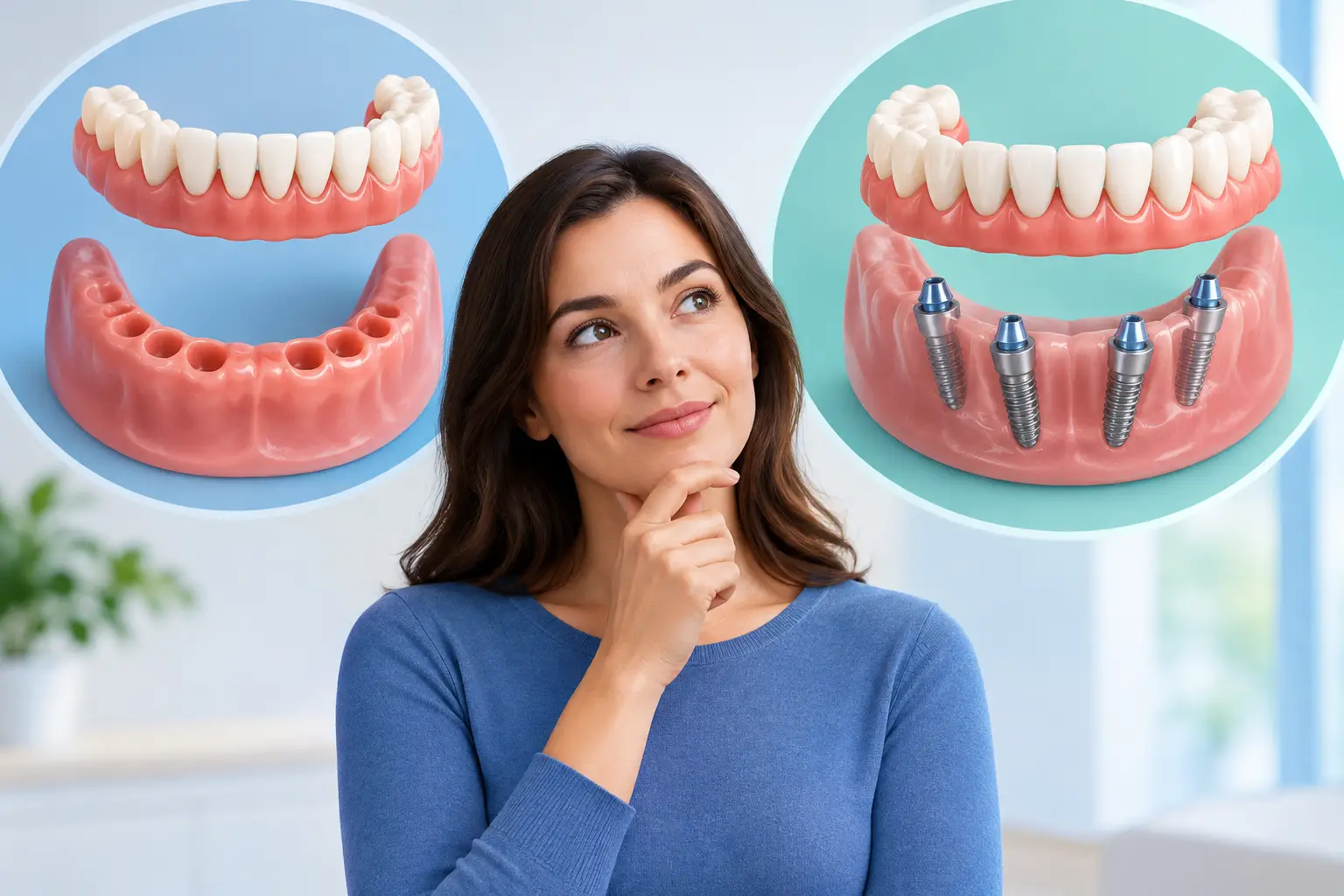
However, healthy teeth in the opposite arch may remain. A patient may receive All-on-4 on the upper arch while keeping healthy lower teeth, or vice versa. In other cases, a person may have enough healthy teeth that a more conservative approach, such as individual implants, crowns, bridges, or a partial denture, makes better sense than full-arch treatment.
The goal is not to remove teeth because implants are available. The goal is to recommend the treatment that gives you the most predictable, maintainable result over time.
When Keeping Teeth May Be the Better Choice
A tooth does not need to be perfect to be worth keeping. Many teeth with fillings, crowns, or past root canal treatment can continue serving well for years when the surrounding gum and bone support are healthy.
Your dentist may recommend preserving teeth when they have a favorable long-term prognosis, can be restored without repeated major procedures, and help maintain comfortable chewing or bite stability. For patients with only a few failing teeth, replacing those teeth individually may be less invasive and better aligned with their needs.
A conservative plan may involve treating gum disease, placing one or more implants where teeth are missing, restoring weakened teeth with crowns, or using an implant-supported bridge. This can be an excellent solution when the rest of the mouth is stable.
There are trade-offs. Saving compromised teeth may require ongoing maintenance and may involve the possibility of future treatment. Choosing All-on-4 can simplify a severely damaged arch, but it is irreversible because natural teeth are removed. A careful conversation about both paths matters.
When Extractions Can Protect Your Long-Term Health
Some teeth are not predictable candidates for restoration, even when they are not painful every day. Advanced periodontal disease can destroy the bone supporting the teeth. Deep decay can extend below the gumline. Cracked roots, recurrent infection, and severe mobility can make a tooth difficult or impossible to keep.
In these cases, holding onto teeth may delay a better solution while allowing inflammation, infection, or bone loss to continue. Removing failing teeth can give the dental team the opportunity to clean infection, evaluate the bone, and build a more stable foundation for implant treatment.
This is especially relevant when several teeth are failing at once. Repairing one tooth at a time can sometimes become a cycle of emergency visits, temporary fixes, and unexpected costs. A full-arch plan may be more efficient when the overall condition of the teeth and gums is poor.
Still, extraction is never a one-size-fits-all recommendation. A thorough exam should include digital imaging, a review of your medical and dental history, a gum evaluation, and a discussion about how you want your smile to feel and function in daily life.
What Happens During All-on-4 Extractions?
When extractions are part of the plan, they can often be completed during the same appointment as implant placement. In many appropriate cases, a temporary fixed bridge is attached to the implants that day or soon afterward. This means you are not expected to go home without teeth in the treated arch.
Immediate teeth are temporary. They are designed to support appearance and function while your implants heal and integrate with the bone. During this healing period, you will need to follow specific instructions, including eating a softer diet and avoiding excessive biting pressure.
After healing, the temporary bridge is replaced with a final custom restoration. The final bridge is made with careful attention to bite, speech, smile appearance, and cleanability. The timing varies based on healing, bone quality, overall health, and whether grafting or additional treatment is needed.
Not every patient is a candidate for immediate loading. If the implants cannot achieve enough initial stability, or if there are concerns about bone volume, infection, bite forces, or healing, a different timeline may be safer. A good plan is built around your biology, not a promise of a particular schedule.
How Specialists Decide What Should Stay and What Should Go
The most reliable recommendations come from looking beyond an individual X-ray or a single painful tooth. Your care team should assess the entire mouth and the long-term future of each arch.
A tooth may be considered for removal if it has severe bone loss, persistent infection, a non-restorable fracture, deep decay, or a poor prognosis after treatment. A tooth may be worth saving if it has strong bone support, manageable decay, healthy surrounding tissues, and a restoration that can be expected to last.
Your bite also matters. Grinding or clenching, uneven chewing forces, and missing teeth can place stress on restorations and implants. Medical factors, including smoking, uncontrolled diabetes, certain medications, and dry mouth, can affect healing and long-term oral health as well.
At Seattle Oral Care, complex cases can be planned with coordinated input from a prosthodontist, general dentist, oral surgeon, and periodontist. That kind of collaboration helps patients understand not only what can be done, but what is most likely to last.
Questions Worth Asking at Your Consultation
You deserve a clear explanation before agreeing to any full-arch treatment. Ask which teeth are not restorable and why. Ask whether there are realistic options for keeping certain teeth, what those options would cost over time, and how their expected longevity compares with an All-on-4 restoration.
It is also reasonable to ask about the temporary bridge, healing timeline, anesthesia and comfort options, maintenance needs, and what happens if an implant or remaining natural tooth develops a problem later. Clear answers can reduce anxiety and help you make a decision with confidence.
A few failing teeth do not automatically mean everything must come out. But if the teeth in one arch are beyond predictable repair, removing them may be the step that allows you to stop managing recurring problems and start building a healthier, more comfortable smile. The best next step is a thoughtful evaluation that respects both the teeth you have and the life you want to live with them.