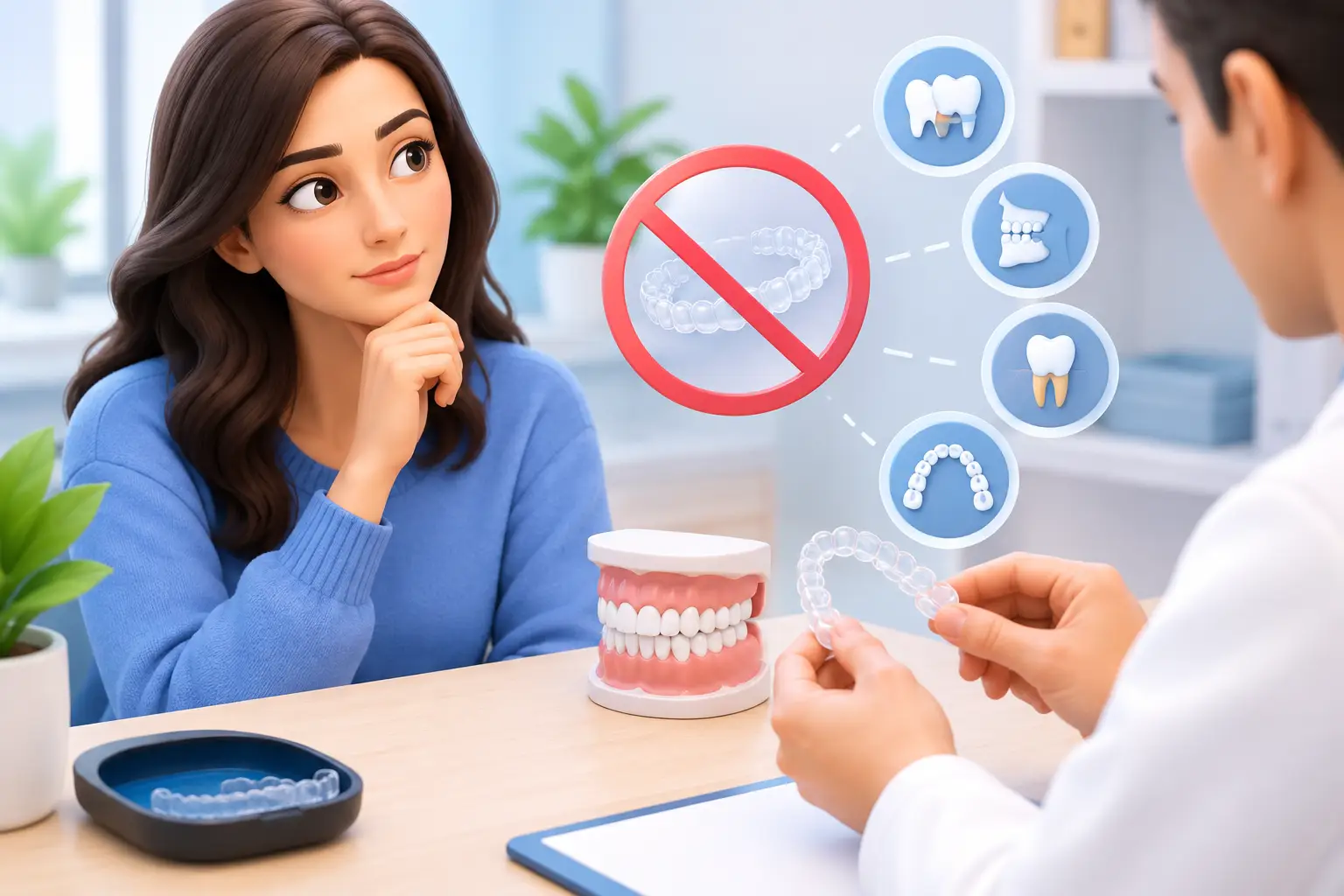
Being told that clear aligners will not work for your smile can feel discouraging, especially if you chose Invisalign for its discreet appearance and convenience. If you were told, “I’m not a candidate for Invisalign,” it is reasonable to ask why, what alternatives exist, and whether an Invisalign second opinion could give you a clearer path forward.
A “no” is sometimes the right clinical answer. Orthodontic treatment needs to protect your teeth, gums, bite, and long-term oral health, not simply make front teeth look straighter. But an earlier assessment is not always the final word. Invisalign technology improvements and a provider’s experience with complex planning have expanded what can be treated with aligners in many situations.
Why Someone May Be Denied as an Invisalign Candidate
Clear aligners move teeth through carefully planned, small changes. They can be highly effective, but they are not identical to braces and do have limitations. A dentist may decide you are a denied Invisalign candidate because of the amount of movement needed, the health of your supporting bone and gums, your bite, or the condition of existing dental work.
For example, a tooth that needs to rotate significantly, move vertically, or shift a large distance can be more challenging to control with aligners. Severe crowding, large gaps, an open bite, crossbite, deep bite, or jaw-position discrepancy may also call for a more detailed discussion. In some cases, braces offer the most predictable way to create certain movements.
The reason matters. “You are not a candidate” can mean several very different things:
- Your teeth and gums need treatment first, such as periodontal care, fillings, or replacement of a failing restoration.
- Aligners may work, but the treatment would be lengthy or less predictable than braces.
- Your case may require attachments, tooth reshaping, elastics, or a combination of aligners and another orthodontic approach.
- Your bite issue may be related primarily to jaw position, which cannot be fully corrected by moving teeth alone.
- The provider may not offer Invisalign for cases beyond a certain level of complexity.
That final point is not a criticism. Responsible clinicians should stay within their training and comfort level. It does mean that a second evaluation with a dentist who routinely coordinates complex care may be worthwhile.
When an Invisalign Second Opinion Makes Sense
An Invisalign second opinion is most helpful when you did not receive a clear explanation, your concern is mostly cosmetic but your answer felt absolute, or you have multiple dental issues that may affect orthodontic planning. It can also be useful if you have been told you need extensive treatment before aligners and want to understand the sequence and purpose of each step.
A second opinion should not be about finding someone who promises the answer you want. It should give you enough information to make a confident decision. A thoughtful consultation includes photographs, digital scans or impressions, X-rays when appropriate, a bite evaluation, and a review of your gum health, existing crowns or bridges, and any history of jaw discomfort.
You should leave understanding what Invisalign can realistically accomplish, where its limits are in your specific mouth, whether braces would be more predictable, and what your treatment will require from you. Clear aligners only work when they are worn as directed, typically 20 to 22 hours a day. Even an excellent plan cannot compensate for aligners that spend most of the day in their case.
Invisalign for Complex Cases: What Has Changed
Modern aligner treatment is more capable than many people realize. Digital treatment planning, more precise scanning, improved attachment designs, refined aligner materials, and better monitoring protocols allow experienced providers to plan many tooth movements with greater control than in earlier generations.
Attachments are one example. These small, tooth-colored shapes are bonded temporarily to selected teeth and give aligners something to grip. They can help guide rotations, improve root control, and create the force needed for movements that would otherwise be difficult. They are visible at close range, but far less noticeable than traditional braces for most patients.
Invisalign for complex cases may also involve other tools. Small amounts of enamel reshaping can create space without removing teeth in selected cases. Elastics may help coordinate the upper and lower bite. Some patients need a short phase of braces for a specific movement, followed by aligners for the remainder of treatment. Others may require restorative work after teeth are moved into healthier, more functional positions.
These additions are not signs of treatment failure. They are often signs of careful planning. The goal is not to force every case into clear aligners. The goal is to select the approach that delivers a stable bite, healthy tissues, and a smile that fits your face and your long-term needs.
Complex Does Not Always Mean Impossible
People with crowns, dental implants, missing teeth, wear from grinding, or prior orthodontic treatment are often told their case is too complicated before a full examination has taken place. These situations do require added planning, but they do not automatically rule out aligners.
An implant, for instance, does not move like a natural tooth. That fact has to be incorporated into the plan, particularly if a final crown or bridge is being designed around the new tooth positions. Existing crowns may affect how attachments are placed. Gum disease must be stable before orthodontic movement begins. For patients with worn or broken teeth, moving teeth may be one step in preparing for durable restorative treatment.
This is where coordinated care is valuable. At Seattle Oral Care, a treatment plan can be informed by general dentistry, prosthodontic planning, periodontal health, and surgical expertise when needed. Rather than viewing straightening in isolation, the team can consider how your bite and smile will function after treatment is complete.
Questions to Ask Before You Decide
You deserve straightforward answers, especially if the first conversation left you uncertain. Ask what specific tooth movements make your case challenging and whether the concern is predictability, treatment time, oral health, or provider experience. Ask whether braces would offer a meaningful advantage or simply a different path to a similar result.
It is also reasonable to ask about refinements. Many Invisalign plans include additional aligners after the first series if teeth do not track exactly as intended or if small finishing adjustments are needed. Ask how often you will be monitored, how treatment changes are handled, and what retainers will be needed afterward. Retainers are essential. Teeth naturally tend to shift over time, no matter which orthodontic method is used.
If you are considering treatment primarily for appearance, talk about what you hope to change. A small gap or mild crowding may be well suited to aligners. If your concerns include chewing difficulty, tooth wear, headaches related to your bite, or repeated damage to restorations, the examination should look beyond the front teeth. A straight smile is valuable, but a comfortable, functional bite is the lasting goal.
A Better Next Step Than Guessing
Do not assume that being denied Invisalign means you have run out of options. It may mean you need a more detailed diagnosis, a different treatment sequence, or a provider with experience planning aligners alongside restorative and periodontal needs. It may also confirm that braces are the safer, more predictable choice for your goals. Either outcome is useful when it is based on a careful evaluation rather than a quick glance.
A second opinion can replace uncertainty with a plan you understand. Whether clear aligners are right for you or not, the best treatment is the one that respects your health, fits your daily life, and gives your smile a foundation built to last.