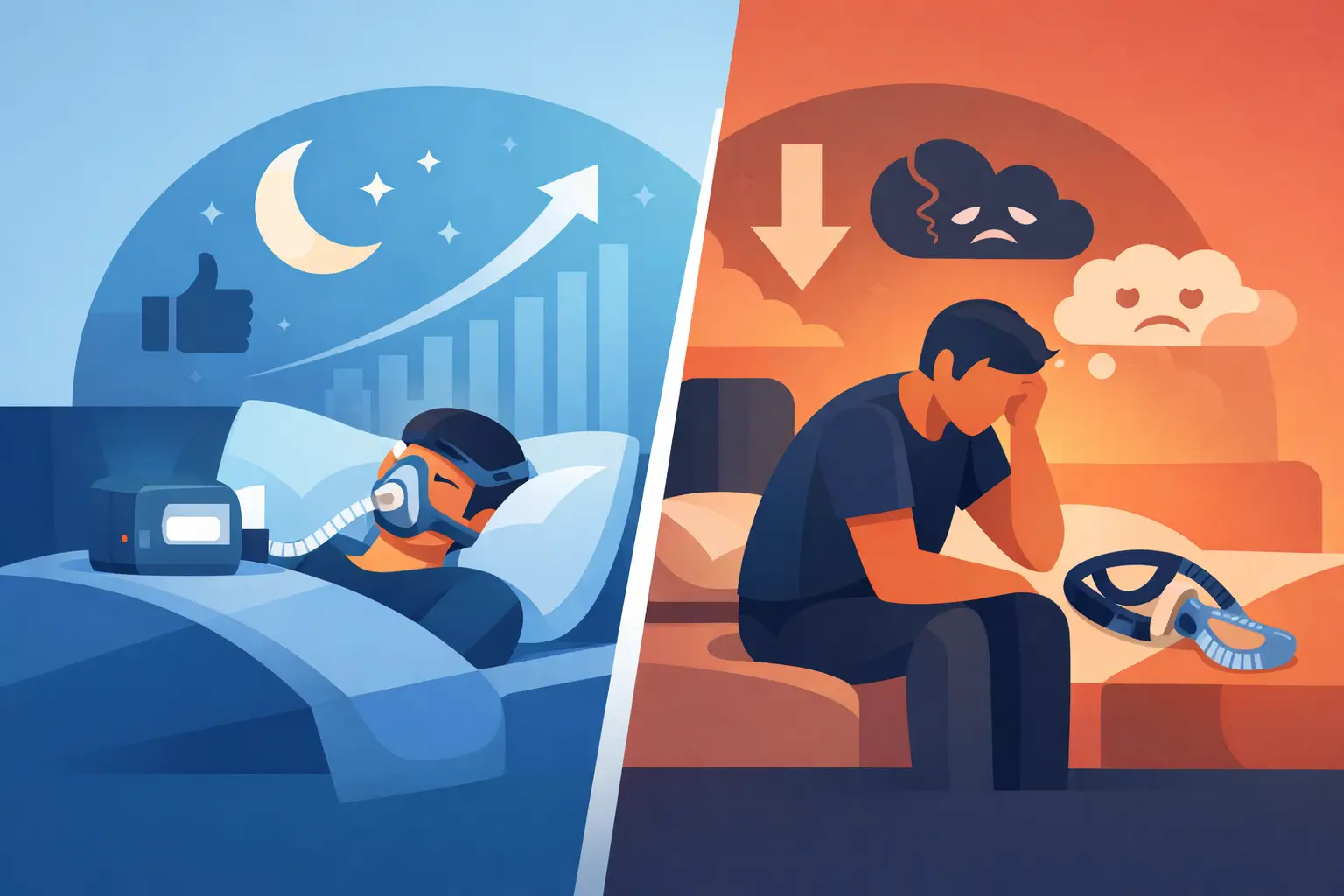
Many people begin CPAP treatment ready to feel better, then find themselves awake at 2 a.m. adjusting a mask, managing air leaks, or taking the device off without realizing it. CPAP compliance rates, CPAP abandonment statistics, and giving up on CPAP matter because untreated obstructive sleep apnea can continue to affect energy, mood, blood pressure, and long-term health.
If CPAP has been difficult, that does not mean you have failed treatment. It usually means the treatment plan needs more attention. Some problems can be corrected with CPAP adjustments. For others, a custom oral appliance may be a more realistic way to treat sleep apnea consistently.
What CPAP compliance rates actually measure
CPAP is highly effective when it is worn properly and used throughout sleep. The key phrase is throughout sleep. A machine sitting on the nightstand cannot treat airway obstruction, and a machine used for only part of the night may leave the later, often REM-heavy hours untreated.
Many insurance programs define compliance as using CPAP for at least four hours per night on 70% of nights during a consecutive monitoring period. This benchmark is useful for coverage decisions, but it is not the same as ideal medical treatment. For a person who sleeps seven or eight hours, four hours of use still leaves a meaningful part of the night without therapy.
Published CPAP adherence figures vary widely because studies use different definitions, timeframes, patient groups, and device data. Historically, studies have reported that roughly 29% to 83% of patients do not use CPAP as prescribed. That broad range is not a contradiction. It reflects a real-world truth: some people adjust well, while others struggle immediately or stop after the first few months.
CPAP abandonment statistics tell only part of the story
CPAP abandonment is harder to measure than it sounds. Some patients never fully start after receiving a device. Others meet the insurance definition of compliance but use it inconsistently. Still others use it for a while, then gradually stop because the discomfort feels greater than the perceived benefit.
For that reason, statistics should not be used to predict whether one individual will succeed. They do show that difficulty with CPAP is common, not a sign of poor motivation. Sleep apnea treatment asks people to change a deeply personal routine: how they fall asleep, move at night, travel, and share a bed.
The most useful question is not, “Can I force myself to tolerate this?” It is, “What treatment can I use reliably enough to protect my health?” A less intrusive treatment that is worn consistently may provide more practical benefit than a highly effective treatment that is rarely used.
Why people consider giving up on CPAP
The reason matters because it determines what should happen next. A poor initial experience is sometimes fixable with coaching and equipment changes. In other cases, the problem is a genuine mismatch between the patient and the therapy.
Mask discomfort is one of the most common barriers. Pressure marks, skin irritation, claustrophobia, a poor seal, and air blowing toward the eyes can make bedtime feel stressful rather than restorative. A different mask style, size, or fitting may help, particularly for patients who were handed equipment with limited follow-up.
Pressure intolerance is another concern. Some people feel they cannot exhale comfortably against the airflow, wake with air in the stomach, or remove the mask in their sleep. Humidity settings, ramp features, pressure adjustments, or a different type of positive airway pressure device may improve comfort. Those changes should be managed through the sleep physician or equipment provider rather than made independently.
Nasal congestion, dry mouth, frequent awakenings, and noise can also affect use. So can practical realities: travel, shift work, caregiving responsibilities, facial hair, anxiety, or a bed partner who is also losing sleep. The clinical chart may say “noncompliant.” The person living with the device often has a more complicated story.
Do not stop treating sleep apnea without a plan
Giving up on an uncomfortable device is understandable. Giving up on sleep apnea treatment altogether can be risky, especially when apnea is moderate to severe or when a person also has high blood pressure, heart disease, atrial fibrillation, diabetes, daytime sleepiness, or a history of drowsy driving.
Before stopping CPAP, speak with the clinician managing your sleep apnea. They can review your sleep study, CPAP data, symptoms, and medical history. Sometimes the right next step is better CPAP support. Sometimes weight management, positional therapy, treatment for nasal obstruction, or another intervention can be part of the plan.
For qualified patients, oral appliance therapy is an evidence-based alternative. It should not be confused with an over-the-counter snoring guard. A custom, adjustable oral appliance is prescribed and fitted by a dentist with training in dental sleep medicine. It gently positions the lower jaw forward during sleep to help keep the airway open.
When an oral appliance may be a good fit
Oral appliance therapy is commonly considered for adults with mild to moderate obstructive sleep apnea who prefer an alternative to CPAP or cannot tolerate it. It may also be appropriate for some people with severe sleep apnea who cannot use CPAP, although that decision requires close coordination with the sleep physician and careful follow-up.
The biggest advantage for many patients is wearability. The appliance is small, quiet, portable, and does not require a mask, tubing, or electricity. That does not make it the best answer for every patient. CPAP generally reduces breathing events more completely when it is used as intended, particularly in severe cases. Yet an appliance can be a meaningful option when CPAP is not being worn enough to deliver its expected benefit.
A thorough evaluation also considers dental health. Healthy teeth and gums, stable restorative work, jaw joint comfort, bite alignment, and the ability to move the lower jaw all affect whether an appliance is appropriate. People with loose teeth, untreated gum disease, significant jaw pain, or certain bite concerns may need dental treatment or a different approach first.
At Seattle Oral Care, oral appliance treatment is guided by an AADSM-certified prosthodontist and coordinated with your medical sleep team. The process begins with a conversation about your sleep study, symptoms, previous CPAP experience, and oral health. If an appliance is appropriate, it is custom designed, adjusted gradually, and monitored for comfort and effectiveness.
A treatment plan should include proof that it works
Feeling less tired and hearing fewer complaints about snoring are encouraging signs, but they do not confirm that sleep apnea is adequately controlled. After an oral appliance has been adjusted to its therapeutic position, the sleep physician may recommend a follow-up sleep test to measure results.
This step is particularly important for patients with moderate or severe apnea, cardiovascular concerns, or persistent symptoms. It helps the care team decide whether the appliance is controlling apnea well, needs further adjustment, or should be paired with another strategy.
Long-term follow-up also protects your teeth and jaw. Oral appliances can cause temporary tooth movement, bite changes, jaw soreness, or dryness in some patients. These effects are usually manageable when identified early, which is why ongoing dental sleep care is part of responsible treatment rather than an optional extra.
If CPAP is not working, start with an honest conversation
You do not need to wait until you have completely stopped using CPAP to ask for help. Bring the device data if you have it, and describe what happens on a typical night: when you remove the mask, what wakes you up, how many hours you realistically use it, and whether you still feel sleepy during the day.
That information can reveal whether a CPAP adjustment is worth trying, whether an oral appliance evaluation makes sense, or whether several approaches should work together. The right treatment is not the one that looks best on paper. It is the one that fits your health needs and gives you a real chance of sleeping, breathing, and feeling better night after night.