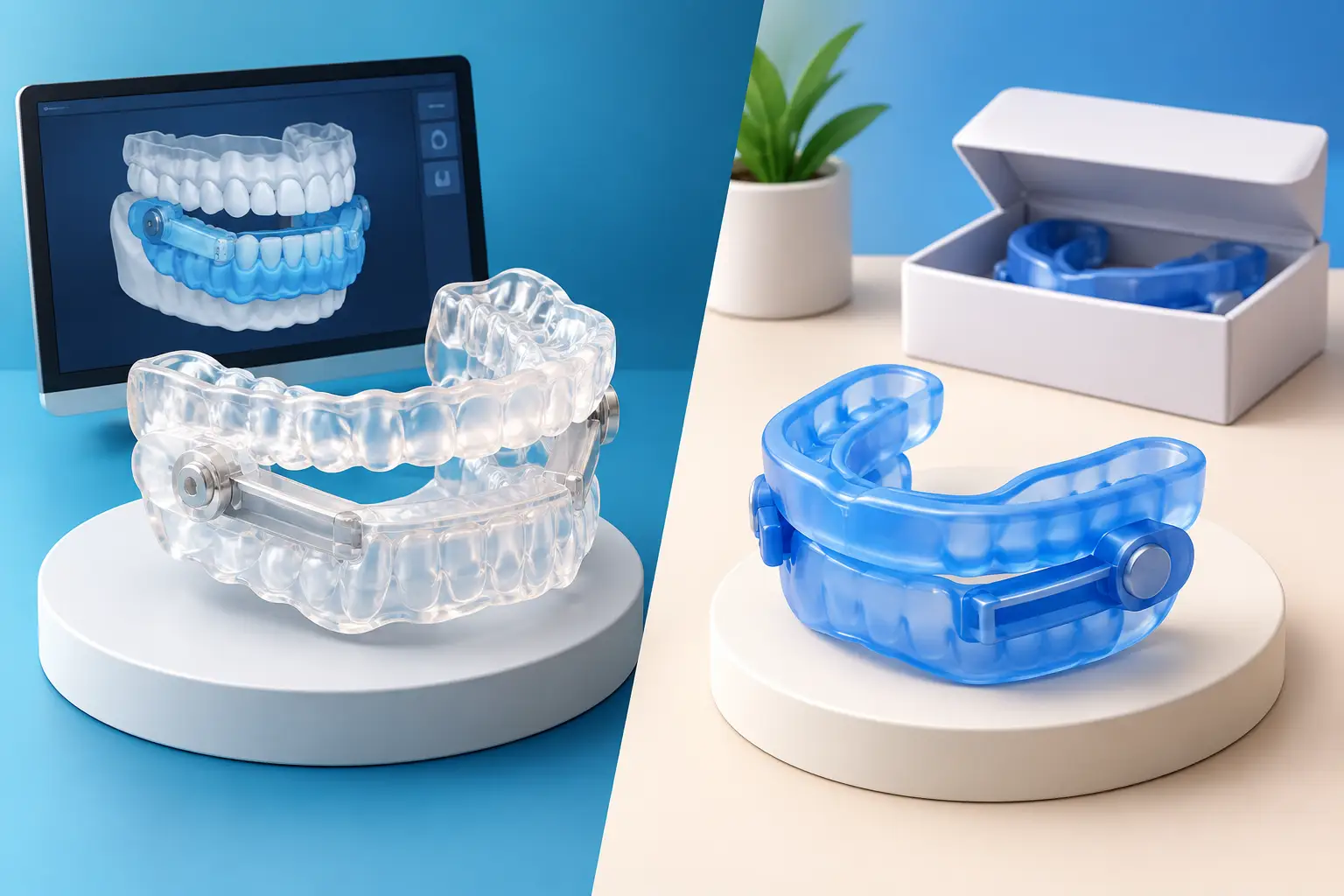
A drugstore device can look like a simple shortcut: choose a package, soften the material, bite down, and take it home. But the custom vs off the shelf mandibular device decision comes down to more than convenience. A boil and bite sleep apnea device and a custom mandibular device for OSA are made, fitted, adjusted, and monitored in very different ways.
For many people, the question is not whether an appliance exists at a lower-effort entry point. It is whether the device can sit securely on their teeth, accommodate their bite, and be managed carefully over time. Those details deserve a thoughtful conversation with a dental professional.
Why Fit Is the Center of the Decision
A mandibular device consists of upper and lower components that fit over the teeth and relate to one another in a prescribed position. That sounds straightforward until you consider how individual every mouth is. Tooth shape, tooth position, existing crowns or bridges, missing teeth, gum contours, bite relationships, and jaw movement all affect how an appliance rests and stays in place.
A custom device is fabricated from detailed dental impressions or digital scans. The dentist uses this information to plan an appliance around the patient’s specific teeth and bite. The goal is not simply to create something that feels snug on day one. It is to create a controlled fit that can be evaluated at each visit.
A boil-and-bite device generally begins as a preformed tray. After it is softened, the wearer bites into it to create an impression. The process can produce a basic tooth shape, but it relies on the person making the device to position it consistently while the material changes shape. If the tray is too large, too small, unevenly softened, or displaced while setting, the resulting fit may be imprecise.
That distinction matters because a device that seems acceptable in the hand may behave differently once it is worn. It may rock, feel bulky along the gums, catch on a restoration, or fail to stay evenly seated. A dentist can look for these details before they become part of a nightly routine.
A Close Fit Is More Than a Tight Fit
People sometimes assume that a tighter device is automatically a better-fitting device. In reality, fit requires balance. An appliance should engage the teeth in a controlled way without creating an awkward pressure point, interfering with a crown, or making it difficult to seat fully.
Custom fabrication gives the dentist and dental laboratory the opportunity to account for fine details, such as tooth contours and areas where a standard tray may not adapt well. This can be particularly relevant for people with dental restorations, teeth that have shifted, spaces between teeth, or a bite that does not fit neatly into a one-size tray.
A drugstore device may be tempting if your teeth appear fairly straight and your bite feels uncomplicated. Even then, what looks simple can be different once a device has to fit both arches together repeatedly. A dental evaluation helps determine whether a preformed design is likely to be workable or whether a custom design is more appropriate.
Custom vs Off-the-Shelf Mandibular Device Adjustability
Fit is only the starting point. A key difference between a custom appliance and many boil-and-bite options is adjustability.
Custom mandibular devices are typically designed with a mechanism that allows the relationship between the upper and lower portions to be changed in small, controlled increments. The dentist provides specific instructions and confirms how the appliance sits after an adjustment. This makes the process deliberate rather than guesswork.
Not every off-the-shelf device adjusts in the same way. Some have limited settings, while others rely on a fixed relationship created during the molding process. A fixed design may leave little room to refine how the device meets the teeth and jaws. If the device no longer feels stable or if the bite pattern changes, the options for modification may be limited.
Adjustability also matters because appliances are not static objects. Teeth, restorations, and oral tissues can change over time. A custom device can be assessed for wear, fit, and its relationship to the bite at follow-up visits. If a component needs attention, a dentist can determine whether it can be adjusted, repaired, or replaced.
Small Changes Need a Clear Plan
The word “adjustable” can make an appliance sound easy to manage without guidance. It is better to think of adjustability as a clinical feature that needs a plan. The amount and timing of any change should be discussed with the dentist providing care.
With a retail device, instructions may tell the wearer to choose a setting or remold the material if the fit changes. That can be difficult to do accurately, especially when the device has two parts that must continue to meet evenly. Repeated remolding can also alter the original impression of the teeth.
A custom device does not eliminate the need for attention. It creates a more controlled framework for it. The dentist can document the starting fit, review changes, and help the patient understand what should be adjusted by the clinician and what should not be altered at home.
What a Dentist Evaluates Before Making a Device
A dental visit is not merely a formality before ordering an appliance. It is the step that turns a general product category into an individualized plan.
The dentist examines the teeth, gums, existing restorations, bite, and jaw movement. They also look at whether there are enough stable tooth surfaces to support the appliance and whether a particular design could place unwanted stress on certain teeth or dental work. For a person with crowns, bridges, implants, removable dentures, or a history of extensive restorative care, this review is especially important.
The evaluation also establishes a baseline. Before a device is made, the dentist can record how the teeth meet and how the jaw moves. That baseline gives the care team something specific to compare during future visits.
For someone tempted by a drugstore device, this is often the most useful question to ask: “Has anyone assessed whether this type of appliance fits my dental situation?” The answer may be that a preformed option is not suitable. Or the dentist may identify a custom design and approach that better matches the person’s teeth and bite.
Follow-Up Care Is Part of the Appliance, Not an Extra
A mandibular device should not be viewed as a purchase completed the day it is made or opened. Follow-up care is part of responsible appliance management.
At follow-up appointments, the dentist can check whether the device still seats fully, whether both upper and lower components remain stable, and whether the adjustment mechanism is functioning as intended. They can inspect the appliance for cracks, worn areas, distortion, and rough edges. They can also compare the patient’s bite to the original baseline and discuss how the device is being handled and cleaned.
This level of review is difficult to replicate with an over-the-counter appliance. A retail device may include general instructions, but it does not include an examination of the person’s teeth, restorations, or bite after weeks or months of use. If the fit changes, the wearer may be left trying to decide whether to remold it, alter it, stop using it, or replace it without clinical direction.
Custom care also creates continuity. If a restoration is added, a tooth moves, or the device is damaged, the dental team already has records of the original design and fit. That history helps guide the next step.
Choosing With the Long View in Mind
An off-the-shelf device may appear to answer an immediate question: can I try a mandibular appliance without scheduling a dental visit? A more useful question is whether a preformed device can be fitted, adjusted, and followed in a way that respects your individual teeth and bite.
Custom care is not about making the decision feel complicated. It is about making the details visible before you commit to an appliance. A careful evaluation, a precisely made fit, a defined adjustment plan, and ongoing follow-up give you a clear path for managing a device over time.
If you are weighing a drugstore option, bring that question to a dentist openly. You deserve a straightforward explanation of how the device would interact with your own mouth, along with guidance that remains available after the appliance is made.