Crowded teeth can make brushing feel frustrating, change the way your smile looks in photos, and leave you wondering whether clear aligners can truly make a difference. Does Invisalign Fix Crowded Teeth? In many cases, yes. Invisalign can gradually move teeth into healthier, more balanced positions, but the right approach depends on how much crowding is present, your bite, gum health, and the condition of the teeth themselves.
For adults who want a more discreet orthodontic option, Invisalign offers a practical path to a straighter smile without the appearance of brackets and wires. A thoughtful examination is still the first step, because not every crowded smile should be treated in exactly the same way.
How Invisalign for Crowding Works
Crowding happens when there is not enough room in the dental arch for teeth to sit in their ideal positions. Teeth may overlap, rotate, tilt forward, or become difficult to clean along the gumline. Some people have naturally smaller arches, while others develop crowding as teeth shift over time.
Invisalign treatment uses a series of custom clear aligners that place gentle, controlled pressure on selected teeth. Each set is worn for a prescribed period before moving to the next. Small tooth-colored attachments may be placed on certain teeth to help aligners create more precise movements.
To create room, your dentist may recommend gently broadening the dental arch within safe limits, moving teeth into available space, or carefully reshaping tiny amounts of enamel between teeth. This last option, called interproximal reduction, is conservative and planned precisely. In more complex situations, treatment may involve other options, such as removing a tooth or coordinating care with a specialist.
The goal is not simply to make teeth look straighter. Properly planned orthodontic treatment also considers bite function, gum health, tooth stability, and the long-term ability to keep teeth clean.
Can Invisalign Fix Overcrowding at Every Level?
The short answer is that Invisalign can fix overcrowding in many mild, moderate, and even some severe cases. The more useful answer is that severity alone does not determine candidacy.
A person with visible overlap in the front teeth may still be an excellent Invisalign candidate if the bite is stable and the teeth can be moved predictably. On the other hand, a smaller amount of crowding may require more careful planning if there are significant bite discrepancies, gum recession, bone loss, missing teeth, or worn restorations.
Mild vs. Severe Crowding With Invisalign
With mild crowding, aligners can often straighten teeth efficiently by correcting minor rotations and using small amounts of space between teeth. These cases may be relatively straightforward, although treatment still requires consistent wear and follow-up appointments.
Moderate crowding can involve more noticeable overlap, rotations, or teeth that sit partly behind or in front of neighboring teeth. Invisalign can frequently address this level of crowding, but treatment may take longer and may require attachments, enamel reshaping, or refinement aligners near the end.
Severe crowding is more individualized. Teeth may be significantly displaced, the bite may be affected, or there may be limited space to move teeth safely. Clear aligners can sometimes still be the right choice, particularly with detailed digital planning and close supervision. In other cases, braces may offer greater control for difficult movements, or a combination of orthodontic and restorative planning may be recommended.
This is why an in-person evaluation matters. A scan alone cannot replace an assessment of your gums, bone support, bite forces, existing crowns or bridges, and overall dental health.
Invisalign Crowded Teeth Before and After: What Changes to Expect
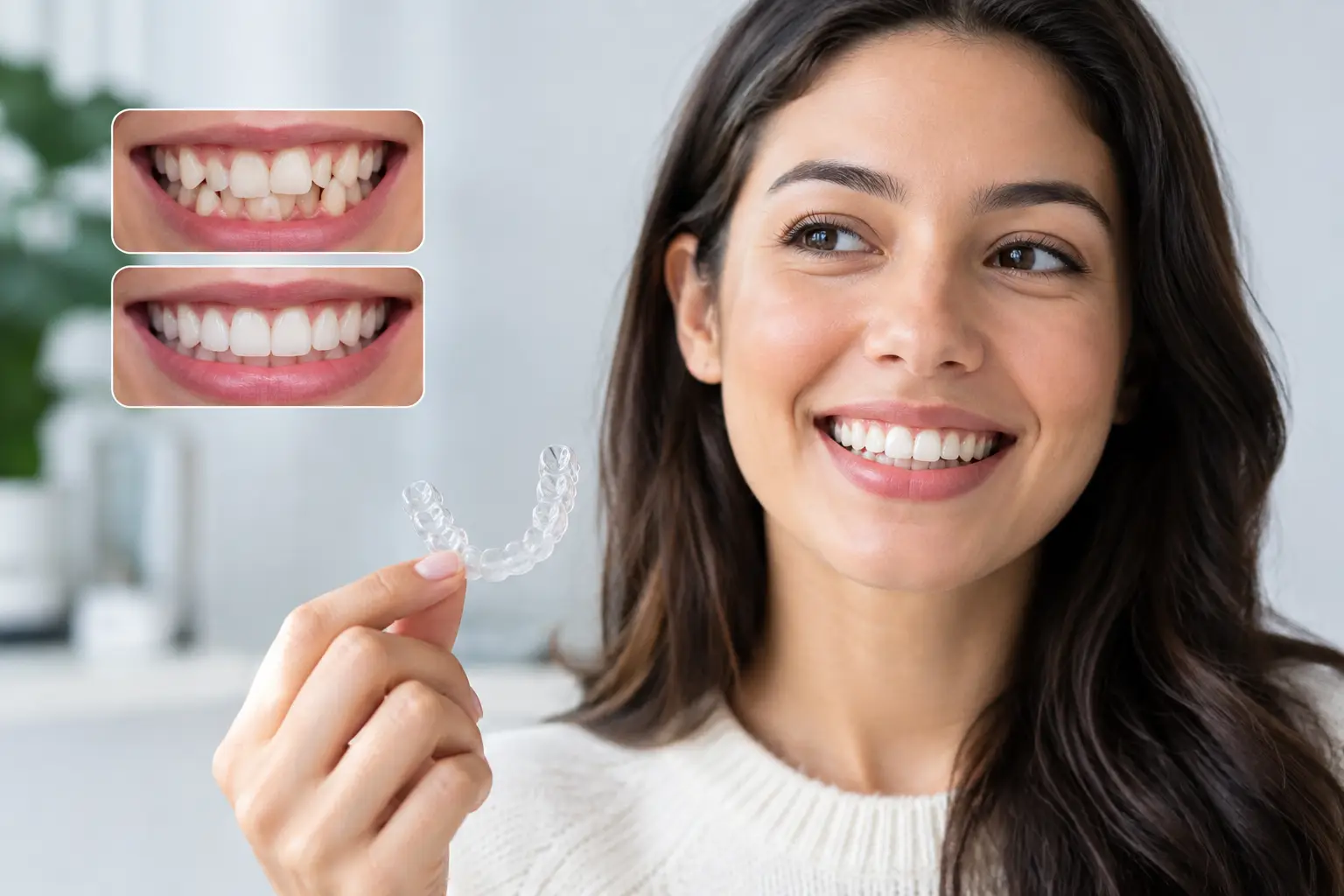
Before treatment, crowded teeth often appear uneven because individual teeth are twisted, overlapping, or pushed out of the arch. After successful treatment, teeth should sit in more orderly positions, with improved alignment and more even spacing. For many patients, that means a smile that feels easier to show and easier to care for.
The most meaningful before-and-after change is often practical. When teeth overlap less, it is generally easier to brush around each tooth and clean between them with floss or interdental cleaners. This can help reduce the areas where plaque tends to collect, though regular home care and professional cleanings remain essential.
Results vary from person to person. Invisalign does not change tooth color, repair chipped enamel, or replace missing teeth on its own. Some patients choose whitening, bonding, veneers, or restorative care after orthodontic treatment to complete their smile goals. Aligning teeth first can make later restorative work more predictable in certain cases.
You should also expect a retention plan. Teeth naturally have a tendency to shift over time, especially after orthodontic treatment. Wearing retainers as instructed is what helps protect the changes you worked for.
Invisalign vs. Braces for Crowded Teeth
When comparing Invisalign vs. braces for crowded teeth, neither option is automatically better. The right choice comes down to the movements needed, your daily routine, and the level of control required.
Invisalign aligners are removable, nearly invisible, and easier to take out for meals and brushing. Many adults appreciate being able to maintain their usual oral hygiene routine without working around brackets. Aligners need to be worn about 20 to 22 hours a day to work as intended. If they are frequently left out, treatment can slow down or become less predictable.
Braces stay on the teeth full-time, so they do not rely on remembering to put aligners back in after every meal. They can be especially useful for certain complex bite corrections, significant rotations, or situations where more direct control is needed. Their trade-off is visibility and the added effort of cleaning around wires and brackets.
There is no benefit in choosing Invisalign simply because it is less noticeable if braces are more appropriate for the clinical goals. Likewise, adults should not assume braces are their only option because their teeth look very crowded. A careful consultation provides a clearer answer than a one-size-fits-all rule.
What Can Affect Your Invisalign Result?
Clear aligners are a partnership between detailed treatment planning and patient follow-through. Wearing aligners consistently is one of the biggest factors in staying on schedule. Removing them only for eating, drinking anything other than water, and brushing and flossing is usually recommended.
Healthy gums are also essential. If gums are inflamed or there is untreated periodontal disease, that should be addressed before orthodontic movement begins. Teeth need stable support from the surrounding bone and gums before they are moved.
Existing dental work deserves attention, too. Crowns, bridges, implants, and veneers do not move in the same way as natural teeth. Patients with restorative needs can still be candidates for Invisalign, but the orthodontic plan should be coordinated with any current or future restorative treatment. This is particularly valuable when the goal is both a straighter smile and a durable, functional result.
At Seattle Oral Care, Invisalign planning is approached as part of your complete oral health picture, not as a cosmetic shortcut. Your team can discuss the position of your teeth, the health of your gums, your bite, and any restorative concerns before recommending the most appropriate path forward.
A Clearer Next Step for a Crowded Smile
If you avoid smiling because your teeth overlap, or if cleaning between them has become difficult, you do not need to guess whether aligners can help. A comprehensive orthodontic consultation can show what is possible, what treatment may involve, and whether Invisalign or braces better fits your needs. The best plan is one that respects your comfort, protects your dental health, and gives you results you can maintain for years to come.