A wedding photo, a work presentation, or a smile that has started to feel unfamiliar can make the question feel urgent: how long does Invisalign take? The honest answer is that treatment is personal. Some adults finish a focused alignment plan in a few months, while a more involved bite correction can take 18 months or longer. The best timeline is not the shortest possible one. It is the one that moves your teeth safely, predictably, and into a position that will last.
For many adults, Invisalign treatment is especially appealing because it fits around a professional and social life. The aligners are clear, removable, and designed around a carefully planned sequence of small tooth movements. But the calendar depends on more than the number of trays in the box.
How Long Does Invisalign Take for Most Adults?
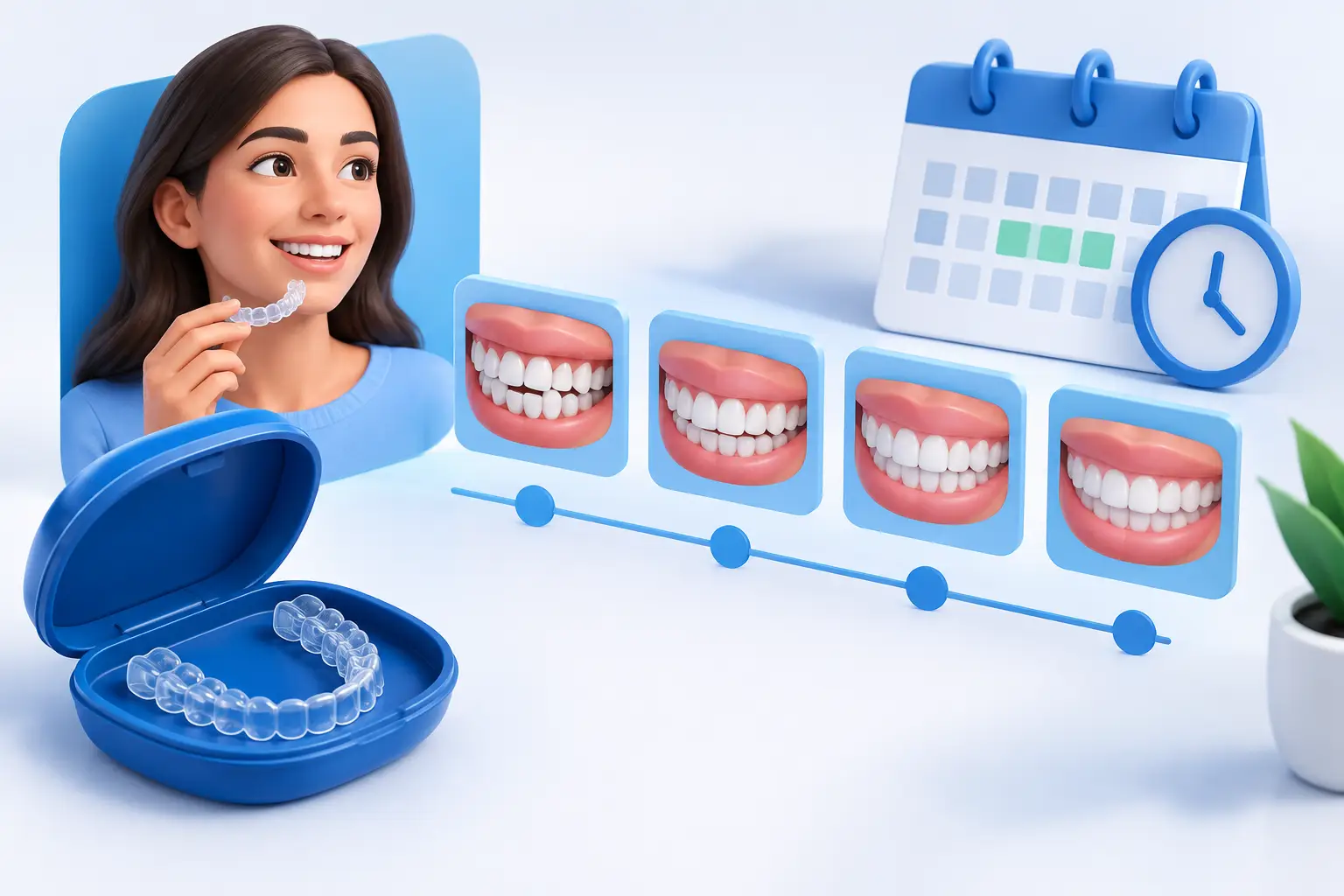
The Invisalign timeline average for comprehensive treatment is often about 12 to 18 months. That range is useful as a starting point, not a promise. Mild alignment needs may take three to six months. Moderate crowding, spacing, or relapse after prior orthodontic treatment often takes six to 12 months. More complex cases, particularly those involving the bite, may take 18 to 24 months or occasionally longer.
Your dentist determines a more meaningful estimate after examining your teeth, gums, bite, X-rays, and digital scans. This evaluation matters because teeth can look fairly straight from the front while still needing more involved movement below the surface. The position of tooth roots, the health of supporting bone and gums, worn teeth, and jaw function can all influence the plan.
A tray change schedule also does not tell the whole story. Some patients change aligners every week, while others wear each set for 10 to 14 days. Each schedule is selected to give the teeth and surrounding tissues appropriate time to respond.
Invisalign Duration: Mild vs. Complex Treatment
The biggest factor in Invisalign treatment length is the type of movement your smile needs.
Minor crowding or small gaps
Minor crowding can often be corrected in a few months, especially when the goal is to straighten the front teeth without major bite changes. Small spaces between teeth may respond just as efficiently. These limited plans can be a good fit for someone who wants a more even smile before a milestone event or who has noticed a few teeth drifting.
Even in a short case, lasting results require planning. Teeth need enough room to align properly, and your dentist may recommend minor reshaping between teeth or carefully managed space changes. Moving teeth too quickly or treating only what is visible can compromise the result.
Teeth that shifted after childhood braces
An adult whose teeth shifted after childhood braces is one of the most common Invisalign candidates. Often, the person remembers a straight smile after braces but gradually notices one lower front tooth rotating, upper teeth overlapping, or a gap reopening.
Relapse cases can be relatively efficient when the bite remains stable and the needed movements are limited. Many fall in the six- to 12-month range. However, prior braces do not automatically mean a quick treatment. If teeth shifted because retainers were not worn, the new plan must still address why the teeth moved and how to keep them stable afterward.
Bite concerns and complex movement
Bite correction typically takes longer than spacing. Closing a small gap or untwisting a front tooth is often more direct than changing how upper and lower teeth meet. Overbites, underbites, crossbites, open bites, and significant crowding may require movements across the entire arch, attachments on selected teeth, and elastic bands worn with aligners.
This is where a thoughtful diagnosis is especially valuable. A bite affects how you chew, how forces are distributed across teeth, and sometimes the health of restorations. The goal is not simply to create a straighter-looking smile. It is to create a comfortable, functional relationship between the teeth whenever possible.
Why Your Timeline Can Change During Treatment
Your digital plan provides a clear road map, but teeth are living structures, not computer graphics. They do not always move at exactly the same pace predicted in a simulation. Regular progress checks help confirm that each stage is tracking as intended.
Attachments are another normal part of many plans. These small, tooth-colored shapes give an aligner something to grip so it can make more precise movements. They may make certain changes possible, but they can also signal that treatment is addressing more than simple cosmetic spacing.
Dental work can affect timing as well. A patient who needs a filling, gum treatment, crown, implant planning, or other restorative care may need treatment coordinated in the right order. At Seattle Oral Care, a multidisciplinary team can be particularly helpful when orthodontic goals overlap with restorative needs. In some cases, aligning teeth first creates the right space or position for a stronger final restoration.
How 22-Hour Daily Wear Affects the Finish Date
For Invisalign to work as designed, aligners usually need to be worn 20 to 22 hours each day. Taking them out for meals, snacks, and brushing is expected. Leaving them out for long stretches, however, gives teeth time to drift away from the planned position.
That is why how 22-hour daily wear affects the finish date is straightforward: consistent wear keeps you close to the original estimate; inconsistent wear can extend treatment. If an aligner no longer fits fully, changing to the next tray on schedule may not be appropriate. Your dentist may ask you to wear the current tray longer, return for an evaluation, or use a replacement aligner.
The practical challenge is often routine, not motivation. Put aligners in their case whenever they are out of your mouth, rather than wrapping them in a napkin. Brush before reinserting them after meals when possible. If coffee is part of your workday, remove aligners for hot or sugary drinks and avoid letting that break become hours.
Refinement Trays at the End of Treatment
Refinement trays at the end of treatment are common and should not be viewed as a failure. After the initial series of aligners, your dentist assesses the actual result, including tooth position, bite contacts, and the details of your smile. If a few teeth need additional adjustment, new scans can be taken for a short series of refinement aligners.
Some patients need no refinements. Others need a few more months to reach the planned outcome. Refinements are one reason it is wise to treat a quoted timeline as an estimate rather than schedule treatment around a fixed finish date. If you have a major event ahead, begin the conversation early and share the date with your dental team.
Retainers After Invisalign Protect the Result
Retainers after Invisalign are not optional if you want to maintain your new smile. Teeth have a natural tendency to shift throughout life, even after successful orthodontic treatment. The same applies whether you had Invisalign, traditional braces, or orthodontic treatment years ago.
Your dental team will recommend a retainer schedule based on your case. Many patients begin by wearing retainers full-time, then transition to nighttime wear as directed. A retainer should also be checked at regular dental visits. If it feels tight after a period of not wearing it, do not force it into place. Contact your dentist for guidance before teeth shift further.
A realistic Invisalign timeline gives you something better than a rushed promise: a clear plan, regular support, and a smile designed to function comfortably long after the final aligner comes out.