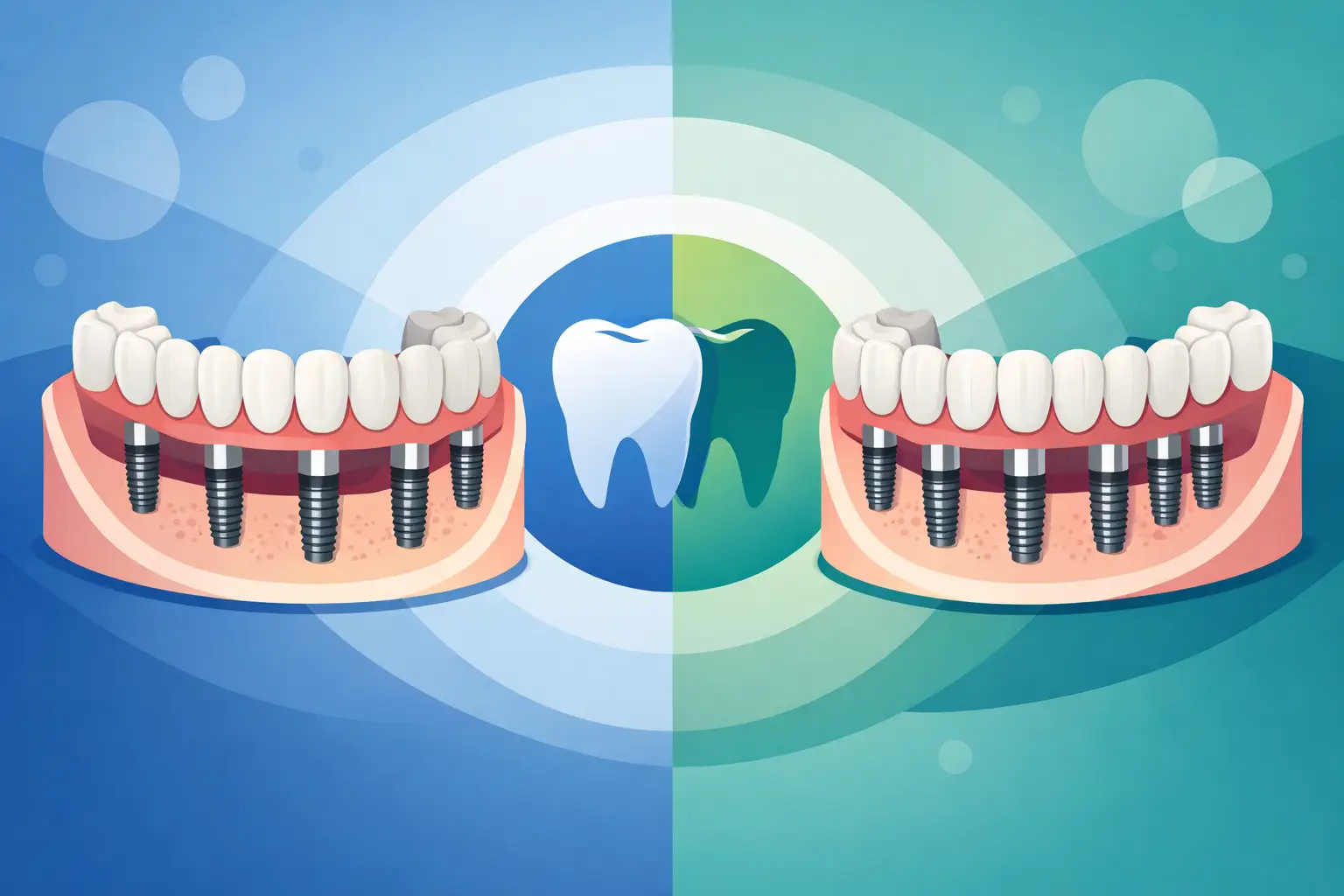
Losing most or all of your teeth can affect far more than your smile. It can change what you eat, how clearly you speak, and how comfortable you feel around other people. Patients commonly ask about all-on-4 vs all-on-6 dental implants , the difference between all on 4 and all on 6 , how many implants for full arch treatment, and all-on-4 versus all-on-6 cost. The answer is not simply that more implants are always better. The right choice depends on your bone, bite, health history, and goals for your new smile.
Both options use dental implants to support a complete upper or lower arch of fixed replacement teeth. Unlike a removable denture, the prosthetic arch is secured to implants placed in the jawbone. That stability can help many people eat and speak with greater confidence while protecting the bone that remains.
What All-on-4 and All-on-6 Have in Common
All-on-4 and All-on-6 are full-arch implant approaches. In each, a carefully planned number of implants support a full bridge of teeth, rather than replacing each missing tooth with its own implant. This can be an efficient solution for someone with failing teeth, an uncomfortable denture, or widespread tooth loss.
Treatment begins with a detailed examination, 3D imaging, and a conversation about your medical history and priorities. Your dentist evaluates the quality and volume of jawbone, gum health, bite forces, facial support, and the condition of any remaining teeth. If needed, damaged teeth are removed before implants are placed.
Some patients receive a fixed temporary arch on the day of surgery or shortly afterward. This is often called immediate loading. It can be a meaningful benefit, but it is not appropriate in every case. Implant stability, bone quality, and the ability to protect the temporary teeth during healing all matter. After the implants integrate with the bone, a final custom bridge is made for long-term function and appearance.
The Difference Between All-on-4 and All-on-6
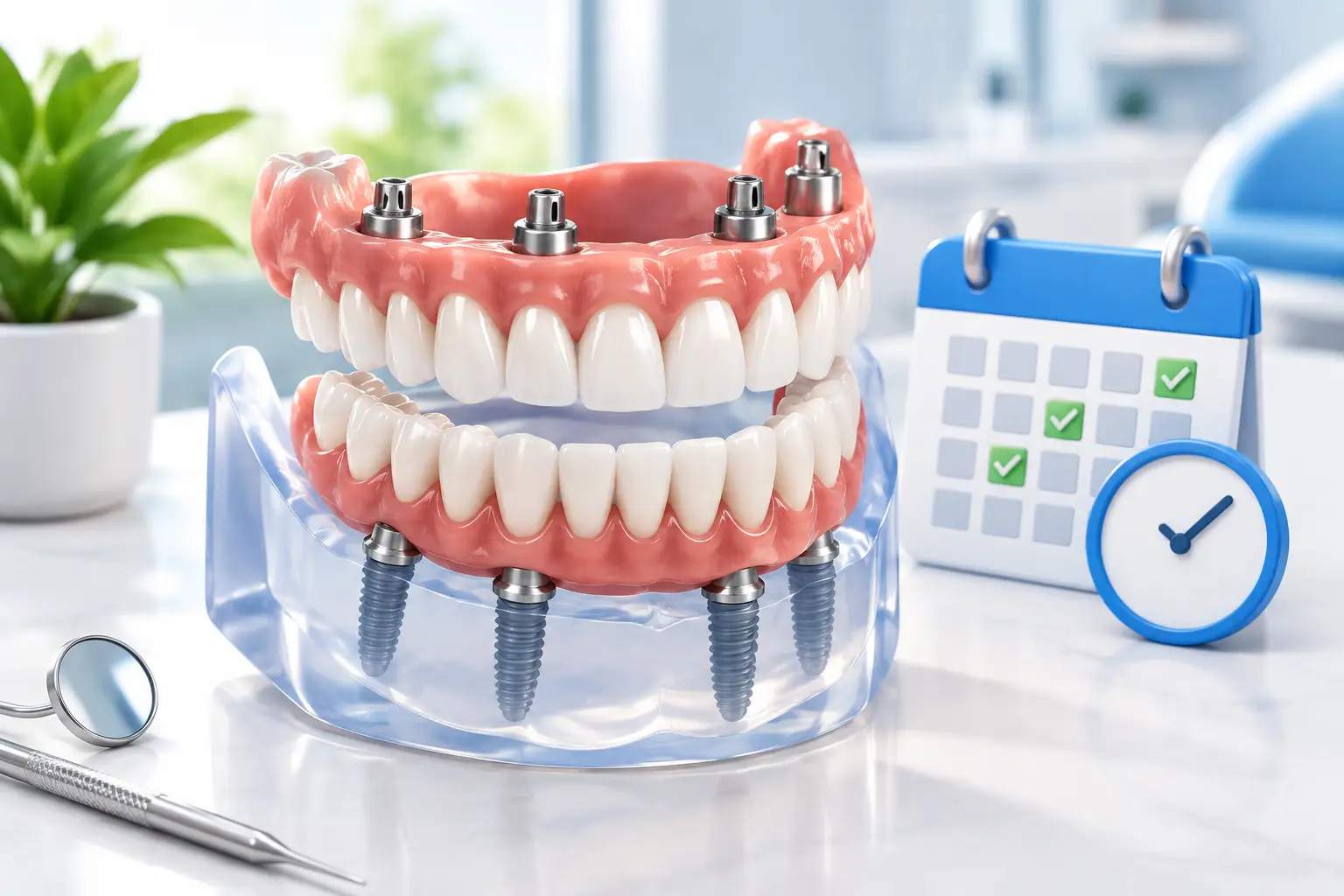
The central difference is the number and placement of implants supporting the full arch. All-on-4 uses four implants. Typically, the front implants are placed more vertically, while the back implants may be angled to make the most of available bone and avoid certain anatomical structures. This approach can reduce the need for bone grafting for some patients.
All-on-6 uses six implants, generally distributed across the arch to provide additional support. With two additional implants, forces from chewing can be spread across more connection points. This may be especially helpful for patients with a strong bite, a history of grinding or clenching, more available bone, or a planned bridge design that would benefit from added support.
Neither option is automatically the “best” treatment. Four well-positioned implants can provide excellent support for an appropriate patient. Six implants may offer greater distribution of force and additional flexibility in the final restoration, but only if there is enough healthy bone in the right locations and the surgical plan supports it.
Why implant position matters as much as implant number
A full-arch restoration is not a simple equation where six always outperforms four. Implant length, width, angle, bone density, arch shape, bite alignment, and the material used for the final bridge all influence long-term performance.
For example, an upper jaw often has softer bone than a lower jaw. A patient with limited bone in the back of the upper jaw may be a strong candidate for a strategically angled All-on-4 approach. Another patient may have sufficient bone and benefit from six implants placed in positions that create a broader, more evenly supported foundation.
This is why a personalized plan matters. A comprehensive team that includes surgical and restorative expertise can coordinate the implant placement with the final teeth in mind, rather than treating surgery and restoration as separate decisions.
How Many Implants for a Full Arch Do You Need?
For many fixed full-arch cases, four to six implants is the common range. However, the number needed is determined by your individual anatomy and restoration plan, not by a one-size-fits-all package.
Four implants may be recommended when bone is limited in the back of the jaw, when angled posterior implants can create stable support, or when avoiding extensive grafting is a priority. Six implants may be recommended when there is adequate bone volume, when additional support is beneficial, or when your bite places more force on the restoration.
Occasionally, a clinician may recommend a different approach altogether. This might include bone grafting before implants, a removable implant-supported denture , individual implants in select areas, or treatment of gum disease before a full-arch restoration. A thoughtful consultation should explain why one path is being recommended and what trade-offs come with the alternatives.
All-on-4 vs All-on-6 Cost: What Changes the Price?
All-on-6 typically costs more than All-on-4 because it involves two additional implants, surgical components, and more clinical time. Still, implant count is only one part of the total investment. A treatment quote should clearly identify what is included so there are no surprises later.
For a single full arch, costs can vary widely based on the complexity of your needs, the type of temporary and final restoration, and whether additional procedures are required. In the Seattle area, a full-arch implant treatment may commonly range from roughly $25,000 to $50,000 or more per arch. An exact estimate requires diagnostics and a complete treatment plan.
Factors that can affect all-on-4 versus all-on-6 cost include:
- Extractions and treatment for infection or gum disease
- Bone grafting, sinus procedures, or other site preparation
- Sedation needs and surgical complexity
- The materials used for the final bridge
- Whether a temporary fixed arch is included
- The number of follow-up visits and long-term maintenance provisions
A lower initial quote is not always a lower long-term cost. The quality of planning, surgical placement, restorative design, materials, and follow-up care can all influence how well the teeth function over time. Ask whether the quoted treatment includes the final prosthesis, not only the surgery or a temporary set of teeth.
Which Option Feels More Stable?
Both All-on-4 and All-on-6 are designed to feel stable because the teeth are fixed to implants. Many patients find this to be a major improvement over a loose or bulky conventional denture. With either approach, your new teeth should be designed to support natural speech, comfortable chewing, and a balanced smile.
All-on-6 can provide additional stability in some cases because more implants share chewing pressure. That does not mean an All-on-4 bridge is unstable. A properly designed All-on-4 restoration can be highly successful when the implants are placed in healthy bone and the patient follows healing and maintenance instructions.
Patients who grind their teeth, have a very strong bite, or want to restore both arches need particularly careful bite planning. Night guards, regular examinations, and professional maintenance may be part of protecting the restoration, regardless of the number of implants used.
Recovery and Long-Term Care
Recovery varies, especially if extractions, grafting, or multiple procedures are involved. Swelling and tenderness are common during the first several days after implant surgery. Most patients can return to many normal activities relatively soon, but they will need to follow a soft-food diet and specific hygiene instructions while healing occurs.
Your temporary teeth are not meant for heavy chewing. Giving the implants time to integrate with the jawbone is essential. Once the final bridge is delivered, you can gradually enjoy a broader range of foods, although very hard foods and habits like chewing ice should still be avoided.
Fixed full-arch teeth need daily cleaning around the bridge and implants, along with regular professional visits. A water flosser, specialized floss threaders, or small interdental brushes may be recommended. Maintenance is not optional. Healthy gums and clean implant surfaces are key to keeping your restoration comfortable and durable.
Choosing With Confidence
The best full-arch solution should feel like a carefully considered health decision, not a sales pitch based on implant count. At Seattle Oral Care, treatment planning brings restorative, surgical, and periodontal perspectives together so patients can understand their options before moving forward.
If you are deciding between All-on-4 and All-on-6 , ask to see how your bone, bite, and planned final teeth influence the recommendation. The goal is a stable, natural-looking smile that is designed for your life, with a plan you understand and feel comfortable choosing.