Waking up tired, dealing with a dry mouth, or hearing that your snoring is keeping someone else awake can make the search for treatment feel urgent. If you are looking for an OAT dental appliance, decision/comparison guide for choosing between sleep dental appliance types , start with this: the best device is not simply the smallest or most comfortable-looking option. It is the one that fits your diagnosis, breathing needs, bite, jaw health, and ability to wear it consistently.
Oral appliance therapy, often called OAT, can be an effective treatment for snoring and obstructive sleep apnea. A properly designed appliance gently supports the lower jaw or tongue in a position that helps keep the airway more open during sleep. For the right patient, it can offer a quieter night, better rest, and an alternative to CPAP that is easier to travel with and simpler to use.
OAT dental appliance choices start with a diagnosis
Snoring and sleep apnea are related, but they are not the same condition. Snoring is the sound of vibrating tissues as air moves through a narrowed airway. Obstructive sleep apnea, or OSA, involves repeated airway blockage during sleep. Those pauses can lower oxygen levels and fragment sleep, even if you do not remember waking.
That distinction matters because an over-the-counter anti-snoring mouthpiece is not a substitute for sleep testing or professional treatment. A sleep physician can diagnose OSA and determine its severity. Your dentist then evaluates whether an oral appliance is appropriate and designs a device that works with your teeth, gums, bite, and jaw joints.
For many people with mild to moderate OSA, a custom oral appliance may be a primary treatment option. It may also be considered for people with severe OSA who cannot tolerate CPAP or prefer an alternative after discussing the benefits and limitations with their sleep physician. CPAP remains highly effective and is often recommended first for severe sleep apnea, especially when oxygen levels are significantly affected.
The main sleep dental appliance types
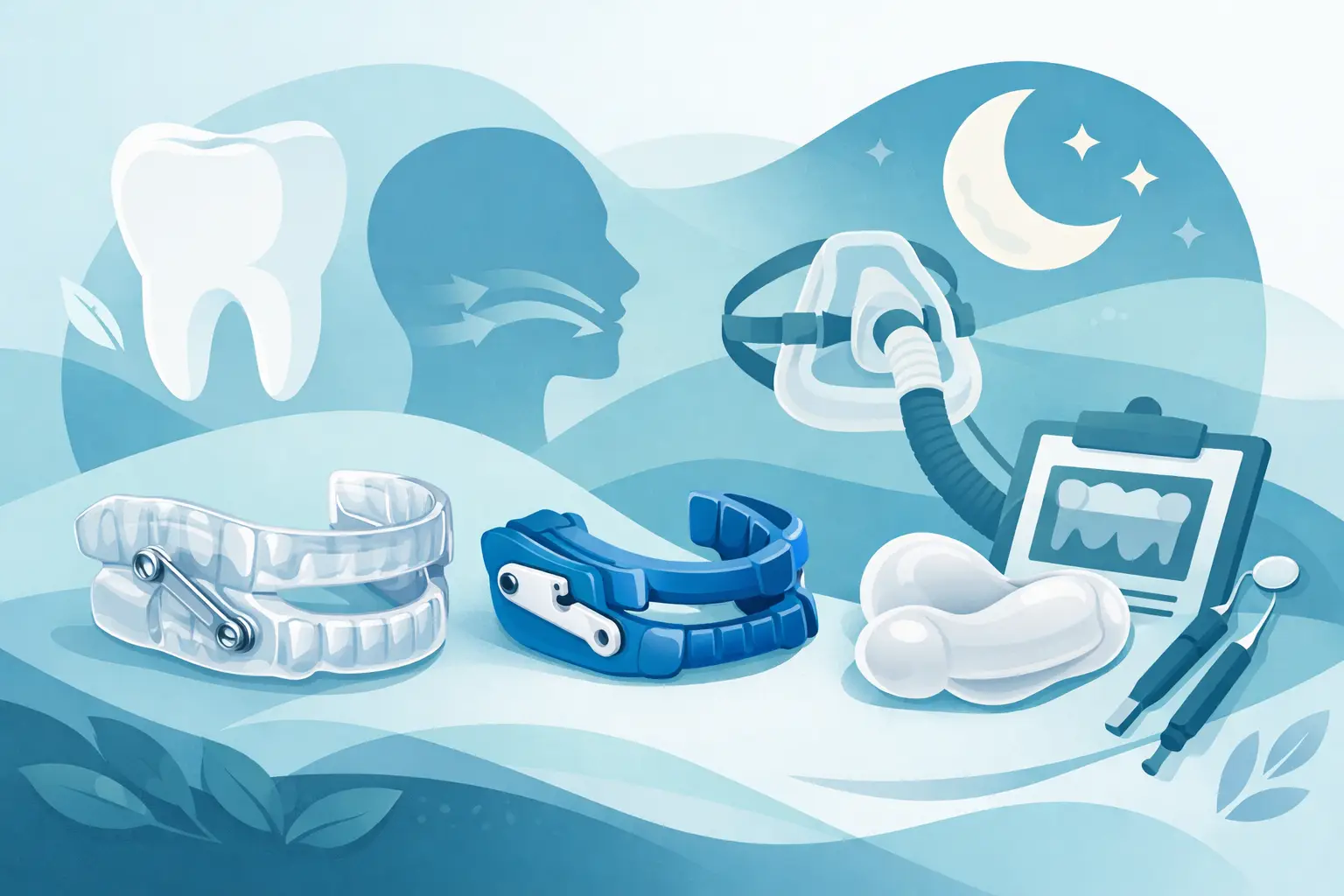
Most sleep appliances fall into two categories: mandibular advancement devices and tongue-retaining devices. The better choice depends on your airway, dental health, comfort, and ability to move the lower jaw forward.
Mandibular advancement devices
A mandibular advancement device, or MAD, is the most common form of oral appliance therapy. It fits over the upper and lower teeth, much like a pair of connected retainers. The device holds the lower jaw slightly forward, helping prevent the tongue and soft tissues from falling back into the airway.
Most custom MADs are adjustable, meaning the dentist can gradually advance the jaw in small increments. This is a meaningful advantage. Moving the jaw too little may not adequately improve airflow, while moving it too far too quickly can cause jaw soreness, tooth discomfort, or bite changes. A titratable appliance allows treatment to be refined based on symptoms, comfort, and follow-up sleep testing.
MADs are often a strong option for patients who have enough stable teeth or well-planned restorations to support the appliance. They can be especially practical for people who want a compact, portable treatment and are willing to attend follow-up visits for adjustments.
Tongue-retaining devices
A tongue-retaining device, or TRD, uses a soft bulb to hold the tongue forward rather than advancing the jaw. It may be considered when someone has limited teeth, cannot comfortably advance the lower jaw, or has a jaw joint condition that makes a mandibular advancement device less suitable.
TRDs can be helpful in select cases, but many patients find them harder to adapt to. The tongue can feel sore or dry at first, and the device may be less convenient to insert and remove. That does not make it a poor option. It simply means the choice should be based on clinical fit rather than popularity.
Fixed versus adjustable appliances
Some appliances are fixed in one jaw position, while others are adjustable. A fixed device may be less complex and can work for select patients, but it offers little room to fine-tune treatment once it is made.
For many patients, an adjustable custom appliance is preferable because sleep-disordered breathing treatment is rarely one-size-fits-all. Your response may change as your weight, nasal congestion, sleep position, dental health, or sleep apnea severity changes. Adjustment gives your care team a way to respond without starting over.
Custom OAT versus store-bought mouthpieces
A store-bought snoring mouthpiece can seem like an easy first step. It is usually less expensive upfront and immediately available. The trade-off is that these devices are not made from precise impressions or digital scans of your teeth, are often bulky, and may place uneven pressure on teeth and jaw joints.
A custom dental sleep appliance is designed around your bite and monitored over time. It should fit securely, allow appropriate jaw movement, and be adjusted carefully. The goal is not only to reduce snoring. It is to treat airway obstruction while protecting your teeth, gums, jaw joints, and long-term bite.
That monitoring is especially valuable for people who clench or grind their teeth, have crowns or bridges, have dental implants, or are already managing TMJ symptoms. Oral appliances can sometimes reduce wear from nighttime grinding, but they are not automatically the right guard for every grinder. The appliance design must account for the forces on your teeth and restorations.
Comparing an oral appliance with CPAP
CPAP uses gentle air pressure delivered through a mask to keep the airway open. It is highly effective when worn consistently. An oral appliance works differently, using the position of the jaw or tongue to improve airway space.
Neither treatment should be framed as universally better. CPAP can provide more predictable control for some people, particularly those with severe OSA. Oral appliances are often easier to pack, do not require electricity, and may feel less intrusive for people who struggle with a mask, tubing, or air pressure.
The treatment that works is the treatment you can use night after night. If CPAP has been difficult, that is worth discussing openly with your sleep physician and dentist. Some patients also benefit from combination care, such as an oral appliance used with CPAP at a lower pressure. Others use an appliance when traveling while continuing CPAP at home, based on guidance from their providers.
Questions that should guide your decision
A good consultation should feel like a conversation, not a sales pitch. Your dentist should ask about daytime fatigue, witnessed breathing pauses, headaches, dry mouth, sleep position, nasal breathing, jaw pain, dental history, and prior CPAP experience. They should also examine the stability of your teeth and gums, your bite, the range of motion in your jaw, and any existing restorations.
Before choosing an appliance, ask whether it is custom-made and adjustable, how it will be monitored, what side effects are possible, and how success will be confirmed. Symptom improvement matters, but feeling better does not always prove that sleep apnea is fully controlled. Your sleep physician may recommend follow-up testing after the appliance has been adjusted to the intended position.
You should also ask what maintenance looks like. Like retainers and night guards, oral appliances need daily cleaning and periodic inspection. Over time, materials can wear, teeth can shift, and the fit may change. Regular follow-up protects both the effectiveness of the device and your oral health.
When your dental health changes the plan
Oral appliance therapy depends on a stable foundation. Active gum disease, loose teeth, untreated decay, painful jaw joints, or major bite changes may need attention before an appliance is made. This is not a setback. It is how a careful plan prevents a sleep treatment from creating new dental problems.
People with missing teeth, implant-supported crowns , dentures , or extensive restorative work can still be candidates for treatment, but the appliance design requires added planning. Coordinated care is particularly valuable when airway treatment and restorative dentistry overlap. At Seattle Oral Care, an AADSM-certified prosthodontist can evaluate how a sleep appliance fits into the larger picture of your teeth, bite, and long-term comfort.
The right sleep dental appliance should make treatment feel manageable, not like another thing to worry about at bedtime. With a confirmed diagnosis, a custom-fit device, and follow-up from both your sleep and dental providers, you can choose a path that supports better breathing and protects your smile.